Showing posts with label Redl Josephine Siccard. Show all posts

Monday, 11 July 2011

Siccard Redl visits 'Haji Baba'


Just across from the sweet bazaar in Diyarbakir in SE Turkey there's a little place that sells good things to eat, including honey and clotted cream for breakfast. It was my friend Selam the masseur who works around the corner that sent me there and I could tell by the mischievous look on his face that he wanted to call me by the same name as the shop. It was 'Haji Baba'. So, now you know. And I thought these flowery pieces by Josephine Siccard Redl were exactly right for the shop, too. Not that I think there's anything at all wrong with them. Their floweriness might not accord with contemporary taste but that's for you to judge. I know that at least one reader will be enthusiastic. And I certainly didn't think it was right to hold them back as she was quite happy to publish them herself.


They remind me of the work that Helene Mass did around the same time of old house covered with flowers or creepers. As the first one is alled 'Aus Tirol' I assume they all show buildings there and date from the period in her career before she left for Istria on the Adriatic. (New readers need to track back and take a look at the three other posts about this artist). Here she displays an interest in construction that she went on to develop in her woodcuts of Venetian luggers. In what I believe are those slightly later works, she achieves a fuller sense of both the construction of the boats, sails and rigging and a tremendous sense of pictorial construction. For all the apparent delicacy of the last two prints of houses, there is an a tough sense of form in all three images. The dramatic angles and subtle use of light and shade in the firstwonerful  image particularly look forward to her very best work in Istria.


I need to add that these are virtually the very last of the stash of about 30 images and that, unless I am very fortunate in my searches, I think these will be the final ones. Because of the nature of the source, I believe all these woodcuts formed part of the artist's estate after her death in Argentina. Look on her works ye mighty, and despair.


Wednesday, 6 July 2011

Josephine Siccard Redl: Vienna


I want to start up Modern Printmakers again with a post about an artist I like very much - and the city she went to live in for a while. Most of these images will be new to readers ( a good enough reason to post them) and all belong to the same genre of picturesque city views aside from the print below, which shows the nearby village of Perscholdsdorf. But then Siccard Redl often portrays Vienna as a village. The earth colours - the browns and the greens - are carefully chosen. Interesting that the gold that she went on to make her signature colour is barely present here.


Although all these prints belong to a particular phase of her life, at least one of them - the one you at the top - may well have been printed after her move to Argentina because it is annotated 'Viena vieja'. Even so, no one seems to have turned up any woodcuts she made in Latin America, which was the last place she lived in. (It's as well to point out here that she annotated work in German, Italian, English and Spanish at different points in her career. This sometimes indicates where she was working but not necessarily).


Her sense of perspective - both pictorial and cultural - is subtle. In this she reminds me of Ada Collier, another favourite. The historical pastiche of parkland hopefully shows what I mean. On one level, it's just a charming piece well away from the modernist take on things. But I think she approaches history as Collier did; it provides a gateway for her own imagination. This would cerytainly be true of her woodcuts of Columbus' caravels. It's the warm tones that captivate here not the ornamentation.


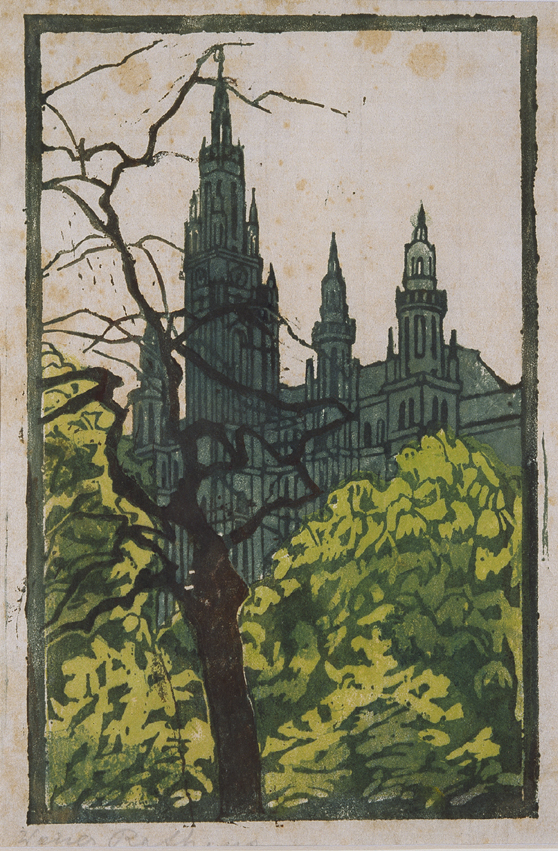
Below, a view of the Rathaus. Not her best piece of work and rather damaged but the use of blue and sharp green is interesting. Basically, she is trying to hide as much of the Rathaus as she can. Architectural detail isn't something that interests her very much.


It's atmosphere and tone that she does best as you see here in the woodcut of one of the allies of the city. There is another version of this woodcut without the child, I think, and in a diffrent colourway but I like the monochrome effect and the way it suggests a genuine wintry feeling. For all it's obvious appeal, it is still some way from the standard snowy scene - and let's face it, in the history of woodcut, there are hundreds and hundreds of those.

Monday, 21 February 2011

Josephine Siccard Redl: lost images of a lost province


Ever since I discovered a cache of images by the Austrian artist Josephine Siccard Redl (1878 - 1938), my admiration for her work has been growing. The purpose of this second post (see JSR: Istria, November 2010) is to share new discoveries and to try and clarify matters, as best I can, to do with her rich and unusual colour woodcuts. Not everyone of the images here were lost. 'Peppers', of the two Istrian country women, is a much better photograph than the one that has been currently available. And I have to say here that I have never seen an actual print by Siccard Redl in front of me and many of the photos that have been available are poor and do not do her work justice. I also made the mistake of judging some of her earlier work, presumably produced in Austria, as rather ordinary. Better images show that they are as good as her Adriatic work but more conventional in their subject matter - old Vienna, or the Tirol. Mea culpa seems an appropriate response.


I know of at least 38 colour woodcuts by her, excluding versions. The night scene of the farmhouse on this post also has a daytime version; 'Bernabitengasse' has variations with figures and different colourways etc. The range of subjects is wide: landscape, Vienna, maritime, flower studies, even a portrait, which you can see above. To go over the basic facts about her: she left Prague with her family to live in Vienna, she worked and presumably lived in the old province of Istria then left for Argentina, where she died at Rosario north of Buenos Aires. I don't know whether she lived permanently on the Adriatic, whether she visited before the first war, and if she continued to make prints of Austria in mid-career. (The interior of Istria had long been part of the Holy Roman Empire, the coastal area controlled by the republic of Venice. Austria took control of the whole area in C18th, with Italy taking over in 1919). Many of her Austrian images are inscribed in German but we have 'Vieja Viena' in Spanish so she must have been producing proofs in Argentina. The fact that many of these images do come from her estate obviously confirm this. Some of the Istrian images are in Italian, others in English. Make of that what you will. Not only did she use four languages, her handwriting changes to some extent. I say all this only because I want to be fair to this - yes, under-rated printmaker. At her best, her colour woodcuts are painterly and rich in a way that very few are.


The cutting is expressive, the printing unfussy, warm tones of golden yellow and brown occur frequently. Her subjects, like these two women, often stand against an unobtrusive linear background that pulls the image together and I think in this she is a student and follower of the Vienna Secession. There is also a considerable imaginative response to her subjects. Take, for example, her portrait 'Giuliano de' Medici'. He was a man; she has portrayed him as a woman. She appears to have based the portrait on the bust attributed to Verocchio but for all the curls, that was obviously of a chap. Is this a self-portrait? I think this is what we would like to know. Or is it a portrait of someone she knows? The donkey-cart, with the load of baskets under a cloth, leaves as many questions unanswered as the facts she offers. Where is the owner and what is the donkey waiting for? Are they a fisherman's creels? I particularly like the three bands of colour and pattern that cart stands against. The ordinary has become mysterious.


'The arbour' at the head of the post gives us the archetypal view of Italy: a pergola with vines, twining roses, the rustic column and intense light. It evokes an idle midday but there is nothing lazy about the bravura representation of shadow and reflection - the flecks of light on the column are intensely telling. She does everything she can here to evoke a response in the viewer. You sense there is an underlying narrative to much of her work.


Which leads me to the series of reconstructions she made of the three ships used by Columbus. There is something rather fantastic about the boat shown here. The interesting thing is that the more details and colours she gives, the more curious it becomes. The fisherman below on the lagoon is more straightforward. I think we can assume that Venice appears on the skyline (she did make a woodcut of Venice which I have been unable to track down). Of course, both Ethel Kirkpatrick and Carl Thiemann used exactly the same subject but neither of them made the work of a fisherman central to the picture. Siccard takes an individual line with an individual place.


Finally, we come to what I assume are Austrian subjects. The sketchy figures and trees remind me of Oskar Laske and suggest that she knew his work. Equally, the quite unrealistic use of an overall subtle green to suggest dusk is admirable. I have to say I'm not quite sure what she has done here. She has signed the image itself, which is more common on linocuts, so they image may have been trimmed for practical reasons. Both prints are intimate but there is a conventional detachment about both of them, I think. I hesitate to say that the Italian work shows someone working from an immediate, passionate response but that is how I see them. Even so, I like this small church scene very much.


Finally, I should say that, so far as I know, I have not so far come across any print with an Argentinian subject. This is curious in itself because it looks as if she continued to print from her blocks once she arrived. Her imaginative involvement in the whole project is beautifully expressed in her woodcuts of Columbus' little fleet. Her obvious love of boats, and everything to do with them, found strong expression in her marriage of historical discovery with the direction of her own life. As the print below suggests, the world is part hidden, part blank, part waiting to be found.


Tuesday, 30 November 2010

Josephine Siccard Redl (1878 - 1938): Istria


If any artist could be a perfect fit for this blog, the Austrian artist Josephine Siccard Redl may well be the one. I say Austrian but she was born in Prague and almost certainly spent only part of her adult life in Vienna. Siccards had been artists there as far back as the late C18th and she herself became a fairly standard colour woodcut artist. Then I take it she moved south to the coast of Istria. And I think it was Istria made her into a mature and quite exceptional printmaker.


The peninsula lies at the head of the Adriactic. When she was born, it was part of Austria- Hungary, with a population of Slovenes and Croations and people on the western coast who spoke a Romance language that is a cousin of modern Italian. This led to the province being given to Italy in 1919. The artist was certainly there some time after that. The first image is inscribed: 'Harbour of Laurana, Italy'. You can see the village marked on the map, across the gulf opposite Fiume. I have to assume she was living there, or in the area, because many of these prints have local connections, but I cannot be sure of this.


The boats are trabacole. They are Venetian luggers, with two masts and triangular, or lug, sails. You will see how well she handles the complex arrangement of masts and sails, rigging and bulwarks. Here is someone with a love of the sea and boats. It is her use of rich brown and gold that marks out this mature work. The boats also have the sturdy treatment of Carl Thiemann with subtle and striking rhythms across the picture plane.


This chapel by the sea is also near Laurana. I specially like the worn uneveness of the path and the shadow. The clarity of the light helps to explain why she went to Istria.


I couldn't be 100% sure that these are Istrian country women but they are drawn with such sympathy, I had to include them. Some Austrian artists at the time went in for images of country people and it's a shame we don't have more figure subjects by her. I like the way she insists on their privacy.


There is nothing shy about these daffodils. I suppose they were a subject she had to tackle at some point. They are stylised but unlike her contemporary English wood-engravers, she knows where to stop. What matters is the subject; the manner of representation is always subordinate. The broad brushwork on the gleaming Chinese jar is in vivid contrast to the jostling daffodils. She is the most painterly of all the colour woodcutters, even more than Thiemann.


One certain fact we have about her is that having come to Italy, she then left for Argentina, where she died at Rosario just north-west of Buenos Aires in 1938. We can only guess at the reasons. In 1922 Mussolini led the blackshirts on the march on Rome and by 1927 there was enforced Italianization of the population of Istria - no education in their own language, for instance.


This next ship is a nao. To be exact it's the 'Santa Maria' that carried Christopher Columbus to the Americas. Whether or not she made these prints in advance of the journey to Argentina or afterwards, I can't say, but I would say before. When I first saw them, I thought at first she had joined the ranks of the galleon artists - they were popular images during the 1920s and 1930s in Britain. But it shows real imagination to turn her attention to historic ships when she is going on a similar journey herself. This isn't the usual historical pastiche. The boat is lively and buoyant.


I have to say 'Bon voyage' until the next post with this last image of Columbus' three ships sailing off into a very Siccard Redl sunset. The 'Santa Maria', which Columbus had never been happy about, was to run aground in the shallows off Hispaniola where he abandoned it. I think you will agree that Josephine Siccard Redl also told a true if poetic story and kept afloat.